Showing posts with label art. Show all posts

Friday, 20 December 2013

Gustav Klimt's Golden phase

Minerva or Pallas Athena 1898
Klimt's most famous pieces of work are those from his gold phase. The main source of influence for these paintings came from the Byzantine mosaic work which he saw in Ravvena and Venice. These mosaics employed the use of gold tiles. Byzantine art usually portrays historical, religious or regal themes. The subjects' poses  are similar to those employed by Klimt. 

Klimt's paintings proved to be critically and financially successful during his lifetime.  The figures in these paintings all appear to be permanent fixtures, never moving from their captured pose. The colours used in these painting convey warmth and almost narrate some untold story captured within the paintings.
Basilica di San Marco-Venice is famous for its Byzantine-style mosaic ceilings.

The topics he chose to paint are truly timeless ones. They are not depictions of current affairs, like a war or a country's political situation, Klimt's paintings depict, above all, beauty, romance and sexual allure. These are themes that can be understood by almost everyone, regardless of race, era or creed.

I chose to use Klimt as a main source of inspiration for my project as I see a sort of surrealistic stillness in his work. His subjects are all given a regal aura because of the way they are placed within the painting. His art from this period is his most famous, however I will be trying to focus on the lesser known (though still famous) pieces of his work.


Pallas Athene of Gustav Klimt: Eyes of a Goddess

Patrick Hunt
[online]
http://traumwerk.stanford.edu/philolog/2006/07/gustav_klimts_pallas_athene_of.html
accessed January 2014

Pallas Athene 1898
Klimt Museum
[online]
http://www.klimt.com/en/gallery/early-works/klimt-pallas-athene-1898.ihtml
accessed January 2014


Monday, 25 November 2013

The Viennese Secession

The Austrian Secession was founded in 1895 by Gustav Klimt, Koloman Moser, Josef Hoffmann, Joseph Maria Olbrich, Max Kurzweil, amongst others.The movement was inspired by the Berlin and Munich Secessions. Their main objectiv was to create an entirely new art form. The movement didn’t maintain any conscious artistic similarities. Their styles and subject matter varied though, naturally, maintained some similarities. 

Melt by Oskar Kokoschka (source)
The mantra of the group was to create so called 'new art'. They wanted to break away from the stuffy traditions upheld by mainstream Austrian Society at the time. They wanted to create art that didn't just reflect reality, they wanted art that had emotion, a story of its own. 


The members of the Austrian Secession mostly drew their inspiration from movements contemporary to their time.The movement was greatly influenced with Japanese art which were popular amongst artists at the time. However, Gustav Klimt was greatly inpressed by the Byzantine mosaic work he saw at Ravenna in Italy.
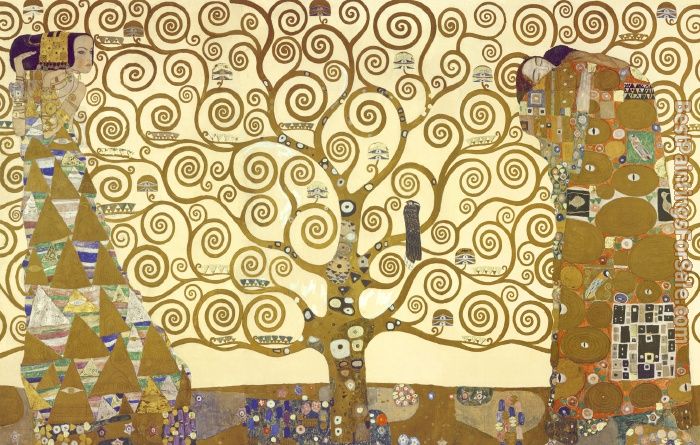
The Tree of Life by Gustav Klimt (source)


Relationship to the topic: Stillness

The ornamentation present in Klimt's work gives his creations a sense if decadent timelessness. His subjects are usually caught in poses that do not give any illusions of captured movement. His subjects appear to be serene and at peace with nature, to be in unity with their surroundings. They are not at war or in conflict with other subjects of the paintings. The peacefulness that can be seen in his paintings can be translated as stillness.


Bibliography:

All that Glitters…The Life and Art of Gustav Klimt by Kitty Wiliams accessed 1.11.13

  http://www.crizmac.com/artandsoul/index.php/2011/12/06/gustav-klimt/

Custav Klimt Biography by studymode accessed 1.11.13*
http://www.studymode.com/essays/Gustav-Klimt-Biography-498087.html

Gustav Klimt by Sonja Blue accessed 1.11.13
http://members.tripod.com/sonja_blue/slash/klimt.html

Essay on Egon Schiele, Abstract Expressionist, Figure Drawing Artist accessed 1.11.13

http://timcody.blogspot.com/2011/05/essay-on-egon-schiele-abstract.html


*a premium subscription to this website is needed to view the entire essay.

Monday, 18 November 2013


The Pre Raphaelites

The Pre Raphaelite Brotherhood was founded in 1848 by  John Everett Millais, Dante Gabriel Rossetti, and William Holman Hunt. All members of the Brotherhood had to submit to four vows which were the bases of all their art. These vows were:


To have genuine ideas to express;

To study Nature attentively, so as to know how to express them;

To sympathise with what is direct and serious and heartfelt in previous art, 

To the exclusion of what is conventional and self-parodying and learned by rote;

And, most indispensable of all, to produce thoroughly good pictures and statues.”  
Proserpine, D.G.Rosseti (source)

Most Pre-Raphaelite work deals with themes from myth, legend or poetry. Their artistic styles varied little throughout the society’s exsistence.

Many works by the Pre-Raphaelites evoke an aura of permanence. Their paintings do not focus on dated themes such as street scenes. Their subjects were characters whose stories are still read today.

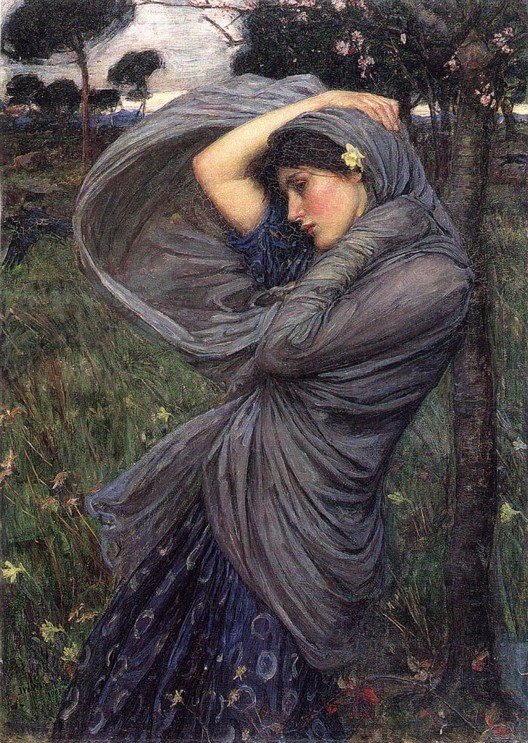
Boreas, J.W.Waterhouse (source)

Their subjects’ poses are more often than not, do not give the impression of excessive motion. In Prosperpine by Dante Gabriel Rosseti the subject, Proserpine seems to have been caught in a pensive moment. She does not maintain the regal appearence ancient Gods and Goddesses are usually portrayed with. The casualness of her pose evokes a sense of familiarity, it makes the viewer feel they are looking at a rendition of a familiar person.

from "Like a Painting" by MIles Aldridge (source)
The work Pre-Raphaelites still is a major source of inspiration for anyone working in the arts field. This can be seen very clearly on the cover of David Bowie’s album, The Man who Sold the World and the Like a Painting photoshoot with Lily Cole by Miles Aldridge which was shot for Vogue Italia in 2005. These modern interpretations just further prove that the Pre-Raphaelites had created a style which will not become leave us anytime soon. 
Album cover for "The Man who sold the World" by David Bowie (source)